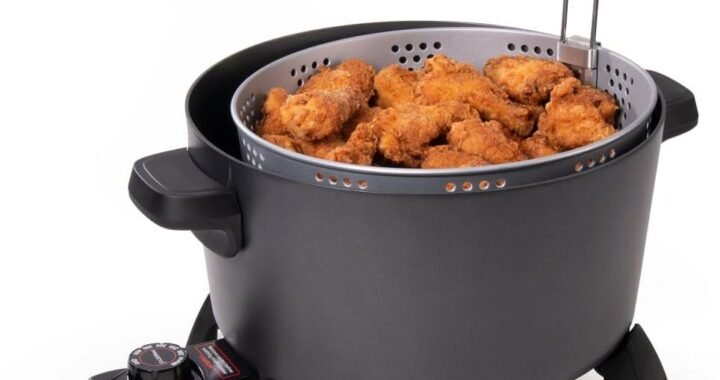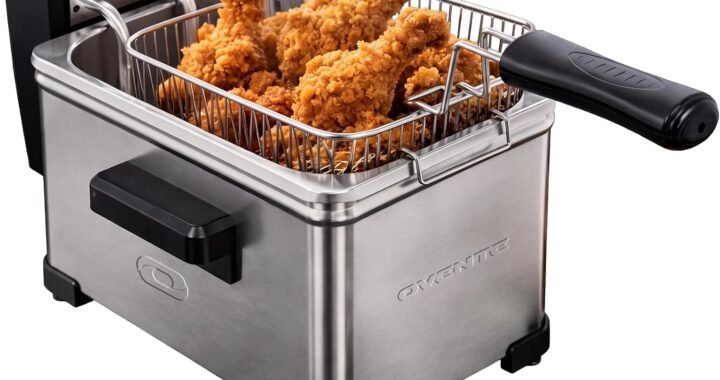
Deep frying is a cooking method that can produce foods with a crisp exterior and a tender interior, but preparing fried food for several people requires more than simply placing a pot of oil on the stove. Oil temperature, cooking capacity, food quantity, basket design, cleanup, and electrical requirements all become important when frying larger batches.
A countertop electric deep fryer can provide a more structured approach to this style of cooking. Instead of relying on a separate pot and manually monitoring a burner, an electric fryer combines the oil container, heating system, temperature controls, and frying basket into one appliance.
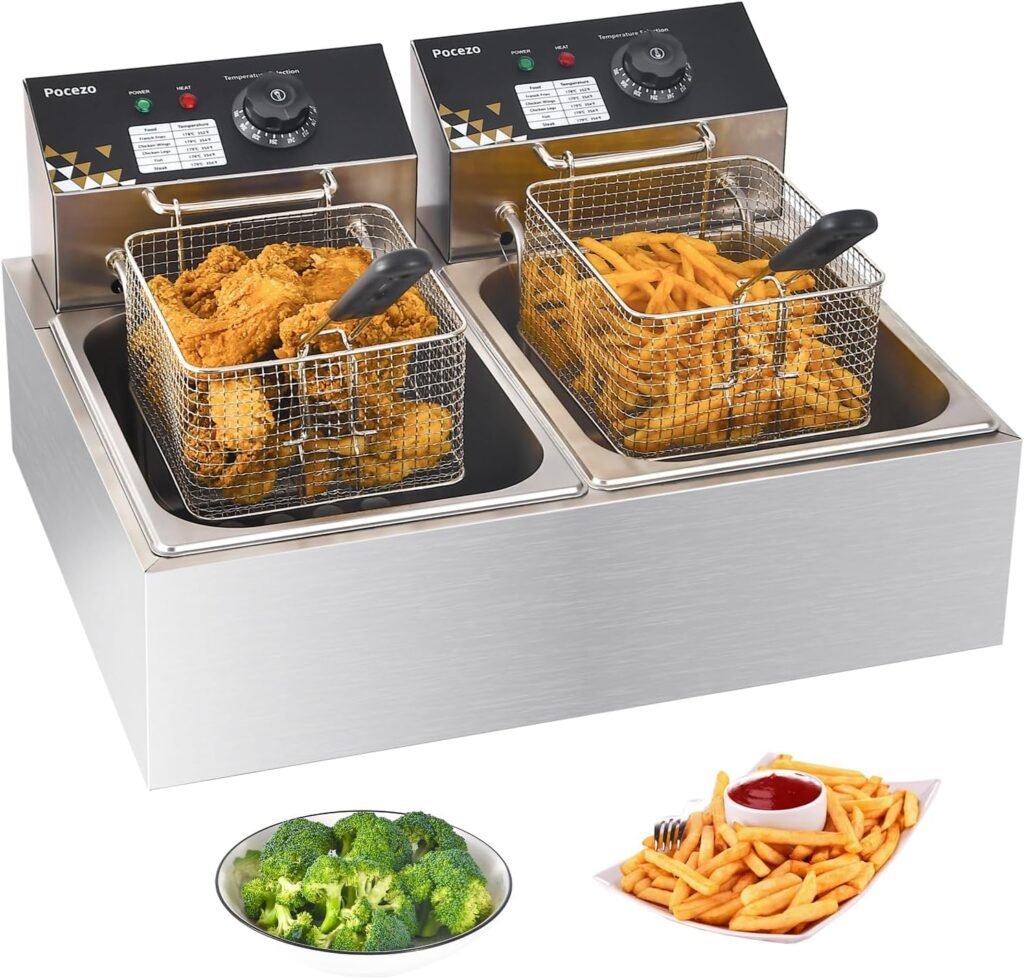
The Electric Deep Fryer 17.2L/18.2QT Stainless Steel Dual Tank Commercial Fryer, identified with Amazon ASIN B0DS1QNW1Y, is designed around this larger-capacity concept. The product listing describes a stainless-steel countertop fryer with a 3400-watt electrical system, baskets, oil-temperature monitoring, adjustable temperature control, and a dual-tank configuration. Product information associated with the listing describes two 1700-watt heating systems and a temperature range of approximately 140°F to 390°F.
The fryer is positioned for both home kitchens and commercial-style food preparation. Its relatively large capacity makes it more relevant to people who regularly prepare multiple servings rather than someone who only occasionally fries a small portion of food.
There is an important point to understand before using or purchasing a fryer in this category: electrical requirements are significant. The product information states that each heating element is rated at 1700 watts and cautions that using both simultaneously requires separate electrical outlets rather than plugging both into the same socket.
This guide explains the product’s general design, how a large electric deep fryer can be used, the role of temperature control, suitable foods, maintenance considerations, electrical and safety considerations, and how this type of fryer compares with other general deep-frying methods.
Introduction to Large-Capacity Electric Deep Frying
Deep frying involves immersing food in hot cooking oil.
Unlike baking or air frying, the food is surrounded by heated oil, allowing heat to transfer rapidly to the food’s surface. The result can be a browned and crisp exterior when the food is prepared correctly.
The process sounds simple, but temperature management is one of the most important variables.
If the oil is too cool, food can take longer to cook and may absorb more oil. If the oil is excessively hot, the outside can brown before the interior is adequately cooked.
This is why dedicated deep fryers generally include thermostatic temperature controls.
The product discussed here uses adjustable temperature control and an oil thermometer, giving the cook a way to monitor and regulate the frying environment. The listed temperature range is approximately 140°F to 390°F, although users should rely on the instructions supplied with the exact product for operating limits.
The fryer is also designed around a relatively large capacity. The product title identifies it as 17.2L/18.2QT, while some secondary product listings show different capacity specifications for related configurations. Because marketplace listings can contain variant-specific information, it is sensible to verify the capacity, basket configuration, and included components on the current Amazon listing before relying on a particular measurement.
Key Features of the Electric Deep Fryer
Large-Capacity Format
The product is marketed as a large-capacity countertop deep fryer.
A larger fryer can be useful when preparing food for:
- Family gatherings
- Parties
- Community events
- Food-service environments
- Restaurants
- Catering-style preparation
- Large household meals
The main advantage of additional capacity is not simply being able to fill the fryer completely. It is having enough room to prepare reasonable batches without repeatedly using a small cooking vessel.
Batch size still needs to be controlled carefully.
Overloading a fryer with too much food can cause the oil temperature to fall, potentially affecting cooking performance.
Stainless Steel Construction
The fryer uses a stainless-steel exterior and cooking structure according to the product information.
Stainless steel is widely used in food-service equipment because it is durable, relatively easy to wipe clean, and suited to kitchen environments.
The material does not mean that the fryer is maintenance-free.
Oil residue can still accumulate around:
- The tank
- Heating assembly
- Basket area
- Exterior surfaces
- Control components
Regular cleaning remains important.
The specific components that can be immersed or washed should always be determined from the manufacturer’s instructions.
Dual-Tank Configuration
The product title identifies this appliance as a dual-tank commercial fryer.
A dual-tank design can be useful because it allows frying operations to be separated rather than requiring everything to be prepared in one cooking area.
Depending on the exact configuration, separate fryer sections can make it easier to organize different foods.
For example, a kitchen might use one side for:
- French fries
and another for:
- Chicken
- Onion rings
- Seafood
This type of separation can also be useful when different foods require different cooking temperatures.
However, users should verify the exact tank arrangement and controls for the specific model before assuming that each section has completely independent temperature control. Marketplace listings for this product family contain variations in capacity and configuration.
3400-Watt Heating System
The listed electrical power is 3400 watts, described as two 1700-watt heating systems.
Power matters in a deep fryer because the heating system needs to bring oil to the desired temperature and then respond when cold or room-temperature food is added.
When food enters hot oil, the oil temperature naturally drops.
A sufficiently powered heating system can help the fryer recover toward its selected temperature.
This is particularly relevant when cooking larger batches.
However, wattage should not be interpreted as a guarantee of a specific cooking result. Actual performance also depends on:
- Oil volume
- Food quantity
- Food temperature
- Basket loading
- Ambient temperature
- Electrical supply
- Heating element design
Adjustable Temperature Control
The fryer uses a rotary temperature control and built-in thermostat.
The product information lists a temperature range of approximately 140°F to 390°F.
Temperature adjustment is important because different foods require different cooking conditions.
For example:
- French fries
- Chicken
- Fish
- Shrimp
- Onion rings
- Mozzarella sticks
- Tempura-style foods
do not necessarily require identical cooking times or oil temperatures.
The correct temperature should come from the recipe or food manufacturer’s instructions rather than using one temperature for everything.
Oil Thermometer
An oil thermometer provides a direct indication of the oil temperature.
This is useful because the dial setting and the actual oil temperature are not necessarily identical under every circumstance.
The oil temperature can change when:
- Food is added
- A large batch is introduced
- The fryer is recovering
- The lid is removed
- The fryer is operating in a cool environment
Monitoring the oil provides additional information during the cooking process.
Frying Baskets
The fryer is supplied with frying baskets, with product information describing one larger basket and two smaller baskets for the listed configuration.
Baskets are useful because they allow food to be lowered into the oil and removed without requiring the cook to handle individual pieces directly.
They also provide a convenient way to drain excess oil after cooking.
The basket can be lifted above the oil so that some of the surface oil drains back into the fryer before the food is transferred to a serving container.
Anti-Scald Basket Handles
The product information describes the frying baskets as having anti-scalding handles.
Handles are particularly important with deep fryers because the basket is exposed to hot oil and steam.
Even when a handle is designed to remain cooler, users should still handle the basket carefully.
Hot oil can cause serious burns, and steam can also be dangerous when the basket is raised.
Non-Slip Feet
The fryer is described as having non-slip foot pads.
Stable positioning is important for countertop cooking equipment.
A deep fryer should be placed on a stable, level, heat-resistant surface with sufficient space around it.
The feet are intended to help keep the appliance in position during use, but they should not be considered a substitute for proper placement.
Overheat Protection
The product information describes an overheat protection system designed to stop heating when the desired temperature is reached or when an overheating condition occurs.
Temperature protection can add an additional layer of control, but it should never replace careful operation.
Users should still:
- Monitor the fryer
- Use appropriate oil
- Avoid overfilling
- Keep water away from hot oil
- Follow electrical instructions
- Never leave hot oil unattended
Lid and Splash Management
The fryer is described as including a lid intended to help reduce oil splashing.
A lid can be useful during storage or when the fryer is not actively being accessed.
However, users should follow the manufacturer’s instructions about whether the lid should be used during active frying.
Hot oil and trapped steam can create hazards if the lid is removed incorrectly.
How the Electric Deep Fryer Can Be Used
French Fries
French fries are among the most familiar foods prepared in a deep fryer.
For fresh potatoes, preparation generally involves:
- Cutting the potatoes into consistent pieces.
- Rinsing or soaking if the chosen recipe calls for it.
- Drying the potatoes thoroughly.
- Heating the oil to the recommended temperature.
- Frying in an appropriate batch size.
- Draining the finished fries.
For particularly crisp fries, many recipes use a two-stage frying process.
The exact method depends on the potato variety, cut size, and recipe.
Frozen French Fries
Frozen fries can also be prepared in a deep fryer.
They are often designed to go directly into hot oil from frozen, but the instructions on the specific product should be followed.
Adding frozen food to oil can cause:
- Vigorous bubbling
- Steam
- Oil movement
- Temperature reduction
For that reason, food should be lowered carefully into the oil.
Never add excessive amounts at once.
Chicken
A large deep fryer can be used for various chicken preparations.
Possible examples include:
- Chicken wings
- Chicken tenders
- Breaded chicken pieces
- Fried chicken portions
- Chicken strips
Chicken requires particular attention because crispness on the outside does not guarantee that the interior is fully cooked.
Use a food thermometer to verify the internal temperature recommended for the specific chicken preparation.
Chicken Wings
Chicken wings can be cooked in batches.
A large-capacity fryer provides room for multiple servings, but the basket should not be overloaded.
Crowding can reduce contact between the food and hot oil and can make temperature recovery more difficult.
A better approach is to divide a large quantity into manageable batches.
Fish
Deep frying is commonly used for fish fillets and breaded fish.
Examples include:
- Cod
- Haddock
- Pollock
- Catfish
- Fish sticks
- Breaded seafood
Fish cooks relatively quickly compared with some thicker foods, so temperature and timing should be monitored closely.
Shrimp
Shrimp can be fried using:
- Breadcrumb coatings
- Flour-based coatings
- Tempura-style batter
Because shrimp can cook quickly, careful timing matters.
Overcooking can affect texture.
Onion Rings
Onion rings are another food suited to deep frying.
The basket can be useful for lowering a batch into the oil and lifting the cooked onion rings for draining.
The coating should be prepared according to the chosen recipe.
Mozzarella Sticks
Frozen mozzarella sticks are frequently prepared in deep fryers.
Because cheese can melt quickly, it is important to follow the package instructions.
If the coating splits, melted cheese can enter the oil and create additional cleanup.
Tempura-Style Foods
Tempura relies on a light batter and hot oil.
Possible foods include:
- Shrimp
- Vegetables
- Mushrooms
- Green beans
- Sweet potatoes
The oil temperature should be monitored because batter-coated food can significantly affect oil temperature when introduced in batches.
Fried Vegetables
A deep fryer can also be used for vegetables.
Examples include:
- Zucchini
- Mushrooms
- Cauliflower
- Pickles
- Green beans
- Eggplant
Different vegetables contain different amounts of moisture, so cooking time and batter selection can vary.
Fried Pickles
Pickles can be coated with breadcrumbs or batter and fried until the exterior becomes crisp.
Because pickles contain significant moisture, they should be handled carefully when entering hot oil.
Drying the exterior according to the recipe can help reduce excessive bubbling.
Preparing Large Batches
The large capacity makes this fryer particularly relevant to batch cooking.
For example, a gathering might require:
- Several portions of fries
- Chicken wings
- Onion rings
- Fried vegetables
Instead of repeatedly setting up a small saucepan, a larger countertop fryer can provide a dedicated frying station.
The food should still be cooked in batches appropriate for the basket and oil capacity.
Who This Type of Fryer May Be Suitable For
Large Households
Families that regularly prepare fried foods for several people may find a larger fryer format more relevant than a small single-basket appliance.
Hosts and Entertainers
People who prepare food for gatherings can use a larger fryer to prepare multiple servings.
Small Food Businesses
The product is marketed for commercial and restaurant use, making its capacity relevant to smaller food-service operations.
However, commercial use should always be evaluated against local electrical, fire-safety, sanitation, ventilation, and food-service requirements.
An appliance marketed as “commercial” does not automatically mean that it meets every regulatory requirement for a particular business location.
Catering-Style Preparation
Large-batch frying can be useful for catering or event preparation where fried foods are part of the menu.
Again, the equipment must be used in accordance with the relevant local regulations.
Home Cooks Who Fry Frequently
A person who prepares fried foods regularly may prefer dedicated equipment over repeatedly heating oil in a stovetop pot.
The main consideration is whether the appliance’s size, cleaning requirements, and electrical demands fit the kitchen.
Important Things to Consider
Electrical Requirements Are Particularly Important
The fryer is rated at 3400 watts, with two 1700-watt heating systems.
The product information specifically warns against plugging both heating systems into the same socket because doing so can overload the outlet. It recommends using two separate outlets.
This is not a minor detail.
Before using a high-wattage countertop appliance, users should confirm that their electrical installation can safely support the required load.
Do not use an extension cord unless the manufacturer specifically permits it and the cord is appropriately rated.
If there is uncertainty about the electrical setup, consultation with a qualified electrician is appropriate.
110V Compatibility
The product title identifies the fryer as a 110V appliance.
Voltage compatibility matters because electrical equipment should be connected to a supply matching its specifications.
The combination of 110V and 3400 watts represents a substantial electrical load.
Users should check the product’s electrical label and instructions before installation.
Do Not Run the Fryer Without Oil
The product information specifically warns users to fill the oil tank before heating and not to operate the fryer dry.
This is an essential operating rule.
Heating elements are designed to operate under the conditions specified by the manufacturer.
A dry heating element can become extremely hot and may cause equipment damage or create a safety hazard.
Always follow the required minimum oil level.
Avoid Water Near Hot Oil
Water and hot oil are a dangerous combination.
Water can rapidly turn into steam when introduced to hot oil, causing oil to splatter or erupt.
For this reason:
- Dry food before frying when appropriate.
- Keep wet utensils away from the fryer.
- Do not pour water into hot oil.
- Do not attempt to wash a fryer while it contains hot oil.
- Keep the electrical components dry.
Do Not Overfill the Basket
A large fryer does not mean the basket should always be filled completely.
Overloading can:
- Reduce oil temperature
- Increase cooking time
- Produce uneven results
- Encourage food to stick together
- Make the basket heavier and harder to handle
A smaller batch can often provide more consistent contact with the hot oil.
Food Moisture Matters
Food containing significant surface moisture can cause oil to bubble aggressively.
For frozen foods, follow the manufacturer’s cooking instructions.
For fresh foods, drying the surface where appropriate can reduce excess moisture entering the oil.
This is particularly relevant when frying potatoes, vegetables, or freshly washed foods.
Oil Selection
Different cooking oils have different characteristics.
Common frying oils include:
- Peanut oil
- Canola oil
- Vegetable oil
- Sunflower oil
- Corn oil
The appropriate choice depends on dietary requirements, flavor preferences, availability, and the oil’s intended cooking temperature.
Always consider allergy concerns when using oils such as peanut oil.
Oil Temperature and Food Quality
Temperature control is central to deep frying.
When food enters the fryer, the oil temperature can drop.
If the fryer is overloaded, recovery may take longer.
This is one reason why batch size matters.
A recipe might specify a particular temperature, but the cook should also observe how the oil responds when food is introduced.
The built-in thermometer can provide useful information during the process.
Oil Filtration and Reuse
Cooking oil does not necessarily need to be discarded after a single use, but its condition should be assessed carefully.
Oil can deteriorate from:
- Repeated heating
- Food particles
- Excessive moisture
- High temperatures
- Long storage periods
If oil is reused, it should be filtered appropriately and stored according to safe food-handling practices.
Oil that has an unusual smell, excessive darkening, foaming, smoking at normal temperatures, or other signs of deterioration should not be used.
Cleaning the Fryer
Cleaning a deep fryer is an important part of ownership.
Food particles and oil residue can accumulate around the cooking area.
The product information states that most components other than the fryer head are detachable for cleaning.
However, detachable does not automatically mean dishwasher safe.
The manufacturer’s instructions should be followed for each component.
Draining the Oil
The basket can be hung on the fryer head after cooking to allow excess oil to drain.
This is useful because it separates two stages:
- Removing food from the oil.
- Allowing excess oil to drain before serving.
When draining the oil itself, make sure it has cooled sufficiently and use an appropriate container.
Never attempt to move a large quantity of hot oil.
Cleaning the Heating Assembly
The heating head and electrical components require special care.
They should not be treated like ordinary cookware.
Avoid immersing electrical components in water unless the manufacturer explicitly states that it is safe.
Cleaning should follow the supplied instructions.
Storing the Fryer
A large fryer requires more storage space than a small countertop appliance.
Before purchasing or permanently positioning it, consider:
- Countertop width
- Cabinet clearance
- Ventilation
- Access to electrical outlets
- Storage for baskets
- Storage for oil
- Cleaning area
An appliance with dimensions listed around 18 inches deep by 22 inches wide and 12 inches high appears substantially larger than many household countertop fryers.
The exact dimensions should be verified against the current product listing because product variants may differ.
Countertop Placement
The fryer should be placed on a stable, level surface.
Avoid positioning it:
- Directly beside a sink
- Under low cabinets where heat or steam could accumulate
- Near flammable materials
- On an unstable table
- Where children can easily reach the hot oil
Adequate clearance should be maintained according to the manufacturer’s instructions.
Comparing General Deep Fryer Categories
Deep fryers are available in several general formats.
Understanding the differences can help determine which style fits a particular kitchen.
Small Household Electric Fryers
Small electric fryers are designed for limited quantities.
They may have:
- Smaller oil capacities
- Smaller baskets
- Lower electrical requirements
- Compact footprints
They can be convenient for occasional frying.
The trade-off is that larger meals may require multiple batches.
Large Countertop Electric Fryers
The product discussed here belongs to this general category.
Typical characteristics include:
- Larger oil capacity
- Higher heating power
- Larger baskets
- Temperature controls
- Stainless-steel construction
- Greater countertop footprint
These machines are more relevant to high-volume frying.
Single-Tank Fryers
A single-tank fryer has one main cooking area.
This configuration can be straightforward to operate and may require less countertop space.
However, cooking two foods with different temperature requirements may be less convenient.
Dual-Tank Fryers
Dual-tank systems provide separate frying areas.
Potential advantages include:
- Cooking different foods separately
- Managing separate batches
- Reducing cross-contact between different foods
- Potentially using different temperatures where independently controlled
The exact capabilities depend on the model.
Users should confirm whether each tank has separate thermostatic control rather than assuming it from the dual-tank label alone.
Stovetop Deep Frying
A traditional pot or Dutch oven can also be used for deep frying.
This approach does not require a dedicated electric appliance.
However, the cook needs to manage:
- Heat
- Oil temperature
- Pot stability
- Thermometer placement
- Food loading
- Oil depth
A dedicated fryer packages more of these functions into one appliance.
Commercial Floor Fryers
Restaurants with high frying volumes may use larger floor-standing fryers.
These can have significantly greater capacities and may be designed for continuous food-service operations.
The countertop fryer discussed here occupies a different category and is more appropriate where countertop equipment is practical.
Deep Fryer Versus Air Fryer
A deep fryer and an air fryer use fundamentally different cooking methods.
Deep Fryer
Food is immersed in hot oil.
Air Fryer
Food is exposed primarily to rapidly circulating heated air.
The two methods can produce different textures and flavors.
A deep fryer is particularly suited to foods where a traditional fried texture is desired.
An air fryer may be more appropriate for someone looking to reduce the amount of oil used during cooking.
Neither appliance replaces the other for every recipe.
Practical Frying Workflow
A structured workflow can make deep frying easier to manage.
Step 1: Prepare the Food
Cut, season, bread, or batter the food according to the recipe.
Step 2: Prepare the Fryer
Make sure the fryer is stable and correctly connected to the electrical supply.
Step 3: Check the Oil
Fill to the required level without exceeding the maximum.
Step 4: Set the Temperature
Use the recommended temperature for the food.
Step 5: Wait for the Oil
Allow the fryer to reach the selected temperature.
Step 6: Load the Basket Carefully
Avoid overloading.
Step 7: Lower the Basket
Lower food carefully into the hot oil.
Step 8: Monitor Cooking
Observe time, color, and oil temperature.
Step 9: Raise the Basket
Lift the basket carefully and allow excess oil to drain.
Step 10: Serve or Transfer
Move the food to an appropriate tray or serving container.
Tips for Better Deep-Frying Results
Keep Food Pieces Similar in Size
Uniform pieces tend to cook more consistently.
Avoid Overcrowding
Give food enough room to cook properly.
Monitor Temperature
Use the fryer thermometer rather than relying only on appearance.
Dry Ingredients When Appropriate
Excess surface moisture can cause aggressive bubbling.
Drain Before Serving
Allowing excess oil to drain can improve the finished texture.
Keep Oil Clean
Remove loose crumbs and food particles between batches when appropriate.
Managing Two Different Foods
A dual-tank fryer can be useful when preparing complementary foods.
For example:
Tank A: French fries
Tank B: Onion rings
Or:
Tank A: Chicken
Tank B: Vegetables
This can help organize a meal without putting different foods into the same oil.
However, cross-contact and flavor transfer should still be considered.
If someone has dietary restrictions or food allergies, separate oil and equipment may be necessary depending on the circumstances.
Using a Deep Fryer for Gatherings
When cooking for a group, preparation becomes particularly important.
Before heating the fryer:
- Prepare all ingredients.
- Arrange breading stations.
- Prepare draining trays.
- Have serving dishes ready.
- Keep utensils nearby.
- Determine batch sizes.
This reduces the amount of time the cook spends moving around while hot oil is active.
A dedicated fryer can become a central cooking station, but it should remain supervised throughout operation.
Deep Frying and Food Safety
Food safety is separate from cooking temperature.
A crisp coating does not necessarily indicate that the food has reached a safe internal temperature.
For meat, poultry, and seafood, use a food thermometer when appropriate.
Avoid relying solely on:
- Color
- Frying time
- Exterior crispness
Cooking times vary depending on:
- Food thickness
- Starting temperature
- Batch size
- Oil temperature
- Coating
- Food quantity
Frequently Asked Questions
What is the capacity of this electric deep fryer?
The product title identifies the fryer as 17.2L/18.2QT. However, some marketplace listings for the same ASIN or related variants show different capacity descriptions, so buyers should verify the current Amazon listing and selected configuration before relying on a specific capacity figure.
How much power does the fryer use?
The listed total power is 3400 watts, described as two 1700-watt heating systems.
This is a substantial electrical load and requires careful attention to the outlet configuration.
Does it use 110 volts?
Yes. The product title identifies the fryer as a 110V countertop appliance.
The electrical label and manufacturer’s instructions should be checked before operation.
Can both heating systems operate at the same time?
The product information describes two 1700-watt heating systems and specifically warns that operating both together should involve separate outlets rather than the same socket.
Users should follow the manufacturer’s electrical instructions precisely.
What temperature range does the fryer support?
Product information lists an adjustable range of approximately 140°F to 390°F.
Always verify the operating range on the appliance and current instruction manual.
Does the fryer have temperature control?
Yes. The product is described as using a built-in thermostat and rotary temperature control.
Does it include an oil thermometer?
Yes. The product title and product information identify an oil-temperature monitoring system.
What foods can be cooked in it?
Depending on the recipe and basket capacity, it can be used for foods such as:
- French fries
- Chicken
- Fish
- Shrimp
- Onion rings
- Fried vegetables
- Mozzarella sticks
- Tempura-style foods
The appropriate temperature and cooking time depend on the specific food.
Is it suitable for frozen foods?
Many frozen foods are designed to be deep fried, including certain fries, chicken products, onion rings, and appetizers.
Follow the frozen food manufacturer’s instructions.
Introduce frozen foods carefully because ice and moisture can cause hot oil to bubble aggressively.
Is the fryer suitable for home use?
The product is marketed for both home and restaurant-style applications.
However, its relatively high power consumption and large footprint mean that the kitchen must have an appropriate electrical setup and sufficient countertop space.
Is it suitable for restaurants?
The product is marketed as a commercial fryer, but suitability for a restaurant depends on the establishment’s volume, electrical infrastructure, ventilation, fire-safety requirements, sanitation rules, and local regulations.
A product being marketed for commercial use does not automatically establish compliance with every local commercial requirement.
Does it have a dual-tank design?
Yes, the product title identifies it as a dual-tank fryer.
The exact basket and tank configuration should be verified against the current listing because marketplace specifications can vary between product versions.
Can different foods be cooked separately?
The dual-tank concept can allow different foods to be separated.
This can be useful for organizing different batches and potentially different cooking temperatures when the specific controls support independent adjustment.
Check the manufacturer’s instructions for the exact model.
Can the fryer cook fries and chicken?
Yes, both are common deep-frying applications.
They should generally be prepared in appropriate batch sizes and at temperatures specified by the recipe.
Can chicken be cooked safely in a deep fryer?
Yes, deep frying can be used to prepare chicken, but the exterior appearance should not be used as the only indication of doneness.
Use a food thermometer to verify the appropriate internal temperature.
Can the fryer be used without oil?
No.
The product information specifically warns that the oil tank should be filled before heating and that the fryer should not be operated dry.
Can water be added to hot oil?
No.
Water should never be intentionally added to hot cooking oil.
The interaction can cause rapid steam formation and dangerous oil splashing.
How should the fryer be cleaned?
The product information states that most components other than the fryer head are detachable for cleaning.
The exact cleaning procedure should follow the manufacturer’s instructions.
Electrical components should be kept away from water unless specifically designed for washing.
Can the frying basket be used to drain food?
Yes. Product information indicates that the basket can be hung on the fryer head to allow excess oil to drain.
How much food should be put in the basket?
There is no universal quantity because it depends on the food and basket size.
Avoid filling the basket so heavily that food is crowded or the oil temperature drops substantially.
Smaller batches may produce more consistent cooking.
Does a larger fryer always cook faster?
Not necessarily.
A larger fryer can accommodate larger quantities, but cooking speed depends on heating power, oil volume, food quantity, food temperature, and batch size.
The 3400-watt heating system is designed for substantial frying capacity, but actual cooking performance varies with conditions.
Can the fryer be placed anywhere on the kitchen counter?
It should be placed on a stable, level, heat-resistant surface with adequate clearance.
Keep it away from water sources, flammable materials, and areas where children can reach the hot oil.
Is an extension cord recommended?
High-wattage appliances require careful electrical planning.
The product information specifically addresses outlet loading and recommends separate outlets when both 1700-watt heating systems are operating.
Do not use an extension cord unless the manufacturer permits it and the cord is appropriately rated.
How much countertop space does it require?
One listing gives dimensions of approximately 18 inches deep by 22 inches wide by 12 inches high, although exact dimensions should be confirmed against the current product listing and configuration.
This is substantially larger than many compact household fryers.
Conclusion
The Electric Deep Fryer 17.2L/18.2QT Stainless Steel Dual Tank Commercial Fryer is designed for people who need more capacity than a typical small countertop fryer can provide.
Its main characteristics include a large-capacity format, stainless-steel construction, dual-tank design, frying baskets, oil-temperature monitoring, adjustable thermostat control, and a 3400-watt heating system built around two 1700-watt heating elements.
The combination of capacity and heating power makes this type of appliance particularly relevant to batch frying. French fries, chicken, fish, shrimp, onion rings, vegetables, and other fried foods can be prepared in quantities appropriate for the available basket space.
The dual-tank format can also provide organizational flexibility when preparing different foods. Keeping foods separate may be useful when preparing a meal with several fried components or when different cooking temperatures are required. The exact level of independent control should be confirmed for the specific configuration.
Temperature management is one of the most important aspects of using any deep fryer. The adjustable control and oil thermometer provide information that can help the cook maintain the intended frying environment. Still, the final result depends on more than the appliance. Food preparation, moisture, batch size, oil condition, cooking time, and temperature all contribute to the finished food.
Capacity should also be considered realistically. A large oil reservoir does not mean that the basket should always be loaded to maximum capacity. Overcrowding can reduce oil temperature and affect cooking consistency. Dividing food into manageable batches can often be more useful than attempting to fry everything at once.
Electrical requirements deserve particular attention with this model. The listed 3400-watt rating represents a substantial load, and the product information specifically warns against operating both 1700-watt heating systems from the same outlet. It recommends separate outlets for simultaneous operation.
That makes electrical planning an important part of using this fryer safely. Users should verify their electrical setup, follow the manufacturer’s instructions, and avoid improvised connections.
The same careful approach applies to hot oil. The fryer should never be operated without the required amount of oil, and water should never be introduced into hot oil. Food should be handled carefully, baskets should not be overloaded, and the appliance should remain supervised during use.
Cleaning is another consideration. Deep frying naturally produces oil residue and food particles, so regular cleaning is necessary. The product information indicates that most components other than the fryer head can be detached for cleaning, while the electrical assembly requires appropriate care.
Compared with a small household fryer, this model is oriented toward higher-volume preparation. Compared with stovetop frying, it provides a dedicated heating system and integrated temperature controls. Compared with an air fryer, it uses traditional oil immersion rather than circulating hot air, producing a fundamentally different cooking process.
For households that only occasionally prepare a small portion of fried food, the size and electrical requirements may be more than necessary. For people who regularly prepare larger batches, host gatherings, or operate a food-service setup where countertop equipment is appropriate, the larger format may be more relevant.
The most important questions are therefore practical ones: Is there enough countertop space? Is the electrical supply appropriate for a 3400-watt appliance? Will the fryer be used often enough to justify its larger footprint? Are there suitable facilities for safely handling, storing, filtering, and disposing of cooking oil? And does the dual-tank configuration match the foods that will actually be prepared?
Those considerations can help determine whether a large electric deep fryer fits a particular kitchen or food-preparation environment.
For anyone researching this style of countertop fryer, understanding the capacity, electrical requirements, temperature range, basket configuration, cleaning process, and safe operating practices is more useful than focusing only on the headline specifications.
A large-capacity fryer can be a practical cooking tool when its size and operating requirements match the job. With appropriate temperature management, sensible batch sizes, careful food handling, and proper maintenance, it can support a wide range of traditional deep-fried recipes for home gatherings and higher-volume food preparation.